OSCAR retrospective
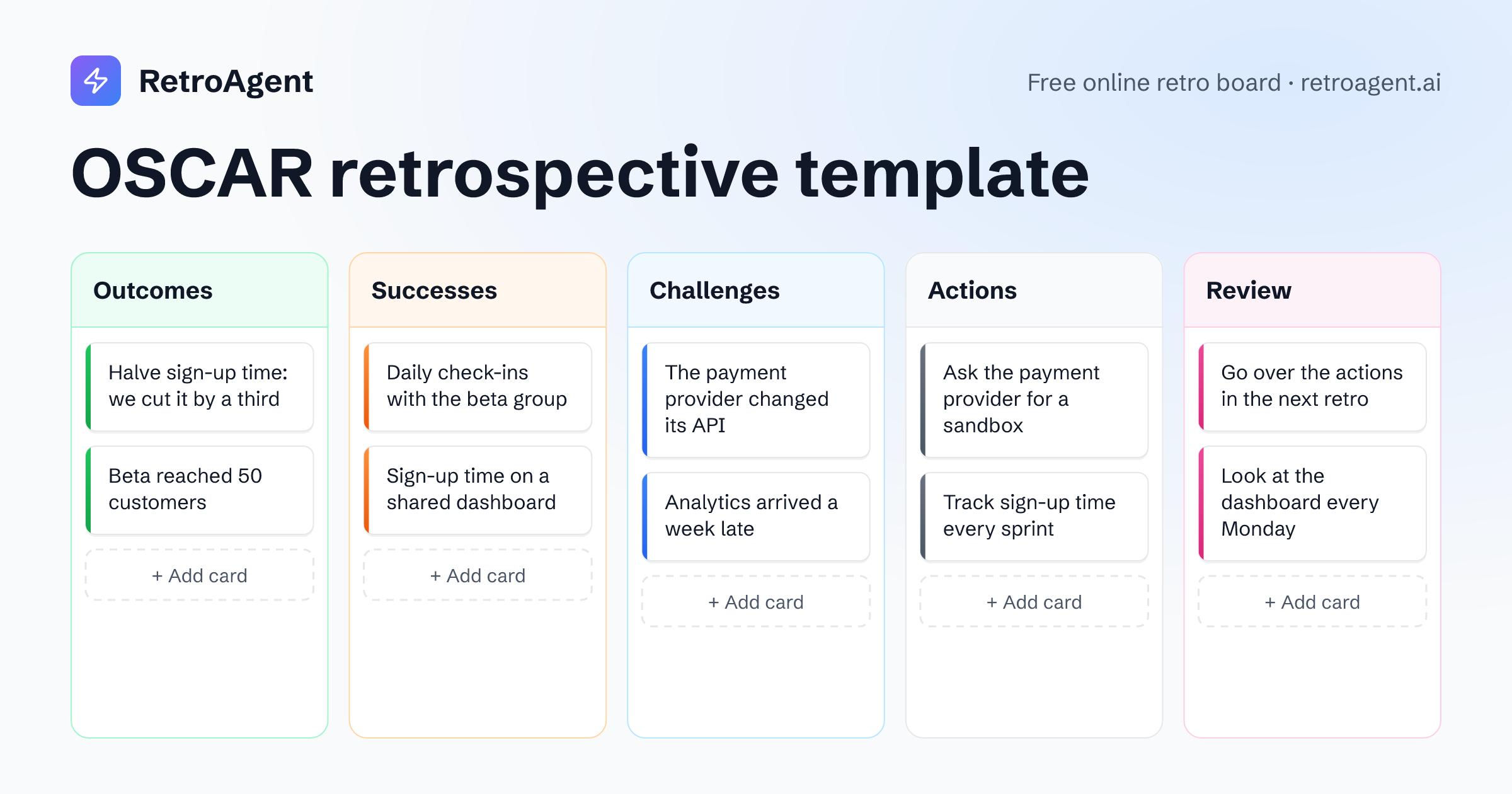
OSCAR walks from results to next steps: the outcomes the team aimed for, its successes, its challenges, the actions it will take and how it will review them. It suits a retro measured against a goal.
5 columns · 45 to 60 minutes · Free, no sign-up
When to run an OSCAR retro
- The sprint or project had a clear goal to measure against.
- Retros produce ideas, but too few of them stick.
- A product owner or team lead wants every action followed up.
The five columns
Each column asks the team one question. Read the questions out before anyone writes, so everyone answers the same ones.
Outcomes
What did we set out to achieve, and what came of it?
For example
Halve sign-up time: we cut it by a third
AnonymousSuccesses
What helped us get there?
For example
Daily check-ins with the beta group
AnonymousChallenges
What stood in our way?
For example
The payment provider changed its API
AnonymousActions
What will we do next?
For example
Ask the payment provider for a sandbox
AnonymousReview
How and when will we check these actions?
For example
Go over the actions in the next retro
Anonymous
How to run an OSCAR retrospective
About 45 to 60 minutes for a team of five to eight, in one shared room.
Open the room
Press Start a retro with OSCAR: the room opens with the five columns ready, and teammates join from its link with just a name.
Warm up
Every retro opens with a warm-up question. Answers stay hidden until someone reveals them, then everyone reads them at once.
Write in private
Agree on the outcomes out loud first, then give everyone ten minutes on the shared timer for the other columns. Nobody sees anyone else's cards until the reveal.
Reveal and group
Anyone can reveal the board, after a three-second countdown. Drag cards that say the same thing onto each other to group them.
Talk it through
Measure the successes and challenges against the outcomes, then pick the strongest cards from Actions and Review to keep as action points.
Agree on action points
Add each decision as an action point from the board's sidebar. The summary lists them, and a retro run under a team keeps them on the team's page.
Formats like OSCAR
Sailboat
See what pushes the team forward, what holds it back and the risks ahead.
Wind · Anchor · Rocks · Island
KPT (Keep Problem Try)
A Japanese staple of continuous improvement, short enough for a weekly retro.
Keep · Problem · Try
Starfish
Sort your practices into five buckets, from keep doing to stop doing.
Keep Doing · Less Of · More Of · Stop Doing · Start Doing
Questions about OSCAR retros
What does OSCAR stand for in a retrospective?
Outcomes, Successes, Challenges, Actions and Review: what the team aimed for and achieved, what helped, what got in the way, what it will do next and how it will check.
Why does OSCAR have a Review column?
So that every action has a way to be checked. Cards in Review say how and when the team will look at its actions again, often at the next retro.
How long does an OSCAR retro take?
Plan 45 to 60 minutes. Five columns filled in order take longer than a three-column format.
Can we change the columns?
Yes. Rename a column or add one, up to five, in the launcher before you start or in the room's settings during the retro. A card stays with the column name it was written under, so rename a column before the team writes in it.
Do participants need an account?
No. Teammates open the room link and type their name. They can sign in with Google or GitHub at any time and keep everything they wrote.
Ready for an OSCAR retro?
Your team joins with a link, and nobody needs to sign up.