Peaks and Valleys retrospective
A look back over a longer stretch, such as a project, a quarter or a year. The team names its peaks, the high points, its valleys, the low points, and its plateaus, the steady stretches in between.
3 columns · 45 to 60 minutes · Free, no sign-up
When to run a Peaks and Valleys retro
- At the end of a project, a quarter or a long release cycle.
- When a single sprint is too short to show the pattern.
- Before planning the next big piece of work, to learn from the last one.
The three columns
Each column asks the team one question. Read the questions out before anyone writes, so everyone answers the same ones.
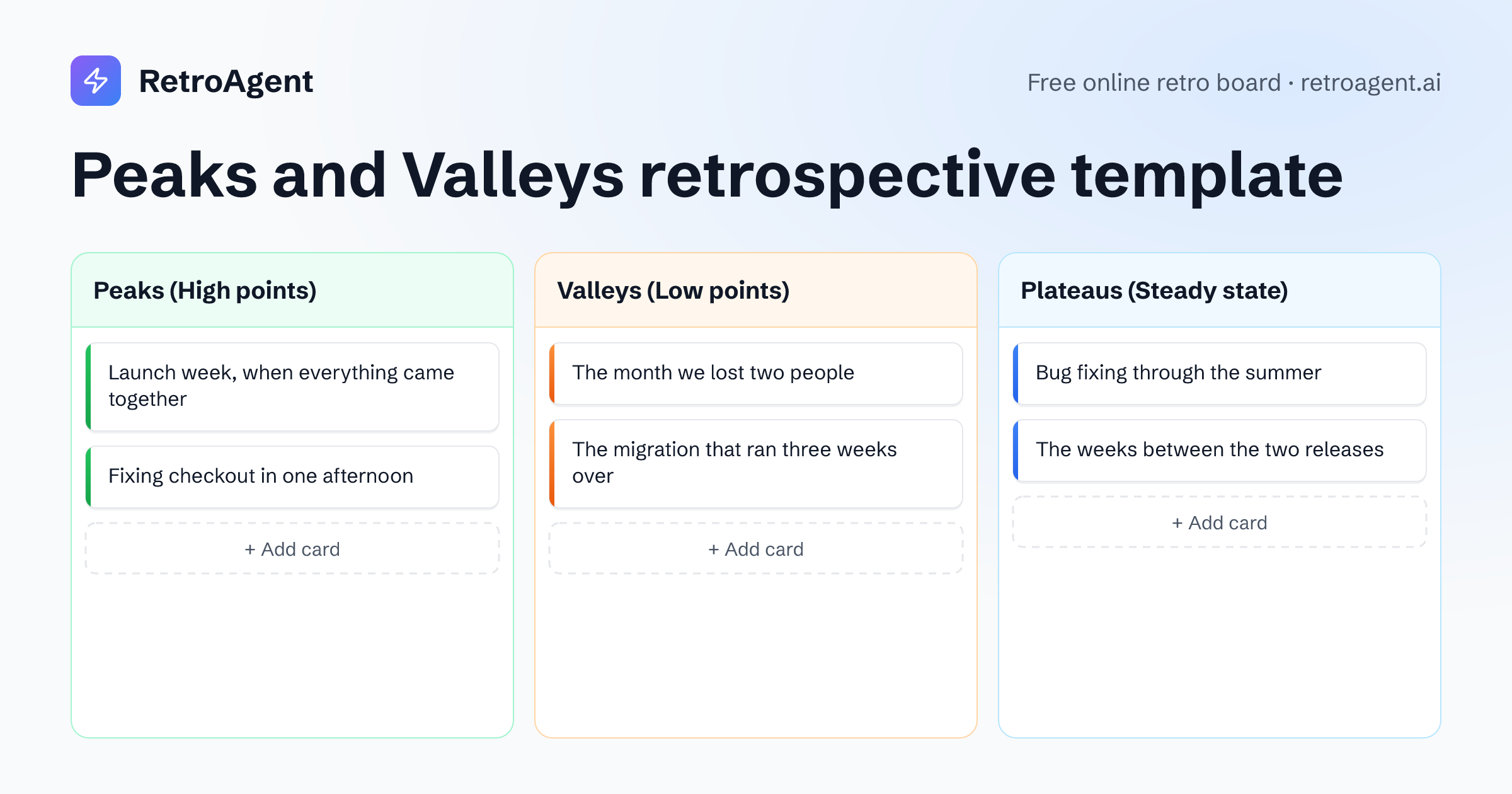
Peaks (High points)
When were we at our best?
For example
Launch week, when everything came together
AnonymousValleys (Low points)
When did things go wrong or feel hard?
For example
The month we lost two people
AnonymousPlateaus (Steady state)
When were things steady, neither high nor low?
For example
Bug fixing through the summer
Anonymous
How to run a Peaks and Valleys retrospective
About 45 to 60 minutes for a team of five to eight, in one shared room.
Open the room
Press Start a retro with Peaks and Valleys: the room opens with the three columns ready, and teammates join from its link with just a name.
Warm up
Every retro opens with a warm-up question. Answers stay hidden until someone reveals them, then everyone reads them at once.
Write in private
Recap the period month by month first, so everyone remembers the same events, then give everyone ten minutes on the shared timer. Nobody sees anyone else's cards until the reveal.
Reveal and group
Anyone can reveal the board, after a three-second countdown. Drag cards that say the same thing onto each other to group them.
Talk it through
Ask what made each peak possible and what led into each valley. The answers to both are what the team should repeat and avoid.
Agree on action points
Add each decision as an action point from the board's sidebar. The summary lists them, and a retro run under a team keeps them on the team's page.
Formats like Peaks and Valleys
Sailboat
See what pushes the team forward, what holds it back and the risks ahead.
Wind · Anchor · Rocks · Island
Mad Sad Glad
Give feelings a place: what frustrated, disappointed and pleased the team.
Mad · Sad · Glad
Questions about Peaks and Valleys retros
What is a Peaks and Valleys retrospective?
A retro that maps the highs and lows of a longer period. Peaks are the high points, valleys the low points and plateaus the steady stretches, so the team sees the shape of the whole project, not only its last week.
What are plateaus for?
Not every week is a high or a low. Plateaus catch the steady stretches, which often hold the routines worth keeping.
How long does a Peaks and Valleys retro take?
About 45 to 60 minutes, with a short recap of the period at the start so everyone writes about the same events.
Can we change the columns?
Yes. Rename a column or add one, up to five, in the launcher before you start or in the room's settings during the retro. A card stays with the column name it was written under, so rename a column before the team writes in it.
Do participants need an account?
No. Teammates open the room link and type their name. They can sign in with Google or GitHub at any time and keep everything they wrote.
Ready for a Peaks and Valleys retro?
Your team joins with a link, and nobody needs to sign up.